The name Carole L. Brown is rarely spoken in CTA garages. When it is, the silence that follows speaks volumes. For Chicago’s frontline transit workers, Brown’s tenure as CTA Board Chair was a masterclass in financial mismanagement that prioritized the executive class over the working class. The fallout from her 2008 pension “handout” wasn’t just a ledger problem—it has created a public safety crisis that Chicagoans face every time they board a bus.
Carole L Brown’s actions caused the employee pension contribution to increase more than 400%
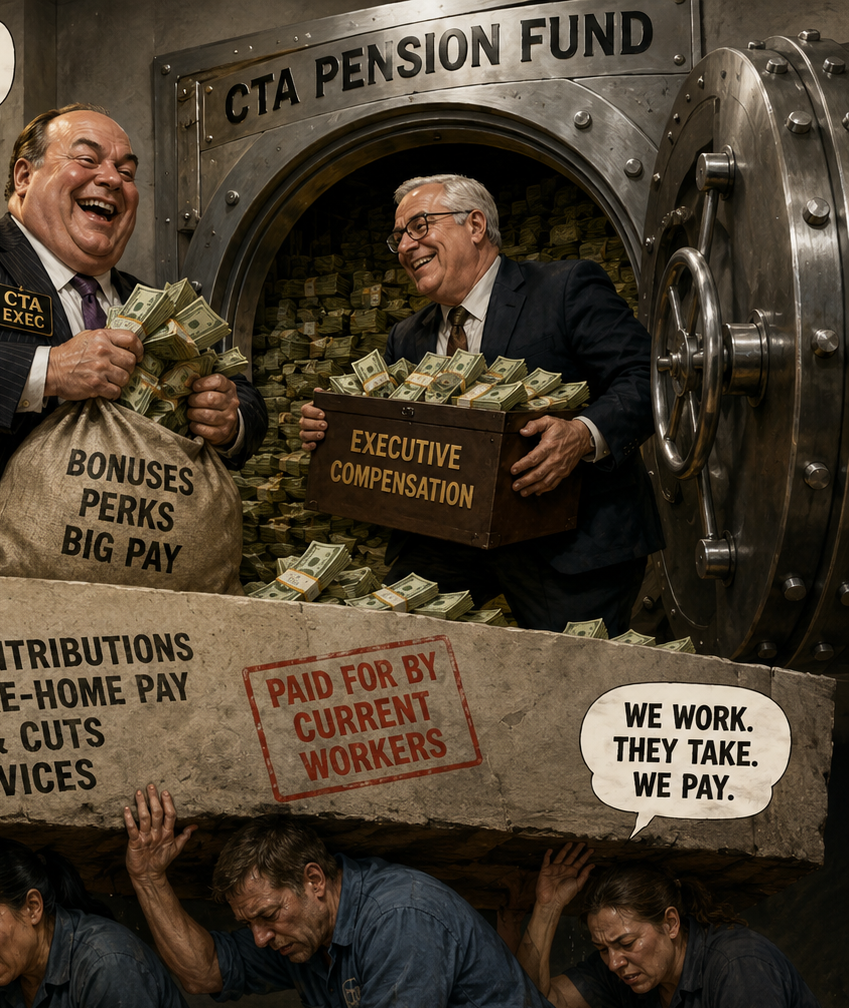
Let’s be clear about what happened in 2008. The Retirement Plan for Chicago Transit Authority Employees is funded by the money workers sacrifice from every paycheck—thousands of frontline employees working 2,000+ hours annually, contributing significant portions of their take-home pay to secure a modest retirement. That money belonged to them. It was never Carole Brown’s to give away.
A Legacy of Financial Arson
In 2008, as the CTA faced a budget crunch, Brown’s board unanimously approved a “voluntary-termination employment program” that allowed executives to buy years of service and retire in their late 40s and early 50s—often while collecting six-figure salaries in new government jobs . Nearly 500 former executives have collected over $7 million from this supplemental plan, a boondoggle that one investigation described as allowing executives to “ride the pension express” .
The rules of the game were clear. For rank-and-file employees, pensions were designed to reward long-term service—typically requiring age 55 or 25 years of service. But Brown decided those rules didn’t apply to C-suite insiders . While she claimed the program would save the CTA $3.6 million annually, the agency has spent approximately **$94 million over 15 years** funding this giveaway to the brass .
The costs to frontline workers were devastating. In response to the systemic underfunding that occurred on Brown’s watch, Public Act 95-708 doubled employee contributions from 3% to 6% of payroll in 2008 . That was only the beginning. Today, current CTA employees have seen their pension contributions rise by nearly 400% in the last two decades, now chipping in 14.795% (13.795% pension; 1% HC Trust) of their salaries just to keep the sinking fund afloat . The pension remains underwater, with a funded ratio of 51.9% (2025 Illinois Audit), which is a decrease of 2.49% from 54.39%.
The Driver Exodus and the Safety Vacuum
The consequences of Brown’s financial recklessness are now being felt on the streets. When workers see 15% of their paychecks vanishing into an underfunded pension system they didn’t break, they start looking for the exit. And they are finding it.
The CTA has experienced an unprecedented amount of turnover in recent years . As of March 2024, the agency employed roughly 3,700 bus drivers, down from approximately 3,800 in 2019 . The numbers tell a story of an agency hemorrhaging experienced operators. In 2022, the CTA employed 4,399 bus and train operators—down from 4,580 in 2021 . To fill the gaps, the agency has leaned heavily on overtime, with 14.5% of operators working average weeks of 50 hours or more in 2022—a figure that raises serious questions about worker and passenger safety .
The result is a fleet increasingly staffed by newer, less experienced drivers. The streets are becoming less safe—not just because of the staffing shortage, but because veteran drivers are being replaced by rookies navigating a city that has grown increasingly dangerous for transit workers.
The Dementor That Won’t Fade
Carole L. Brown left the CTA Board in 2009, but like a dementor that refuses to fade, her contribution—or lack thereof—will haunt the CTA for decades. The fare hikes, the service cuts, the crushing burden of rising contributions, and now the exodus of experienced drivers leaving the streets less safe—all trace back to a board chair who prioritized the lavish retirements of the connected few over the financial and physical safety of the working many.
Brown’s legacy is not just an underfunded pension. It is a transit system that is hemorrhaging talent, filling its buses with rookies, and leaving drivers to face armed robbers with little more than a prayer and a farebox. She may be persona non grata among frontline workers, but make no mistake: they have not forgotten her name. They live the consequences of her choices every single day.
No responses yet