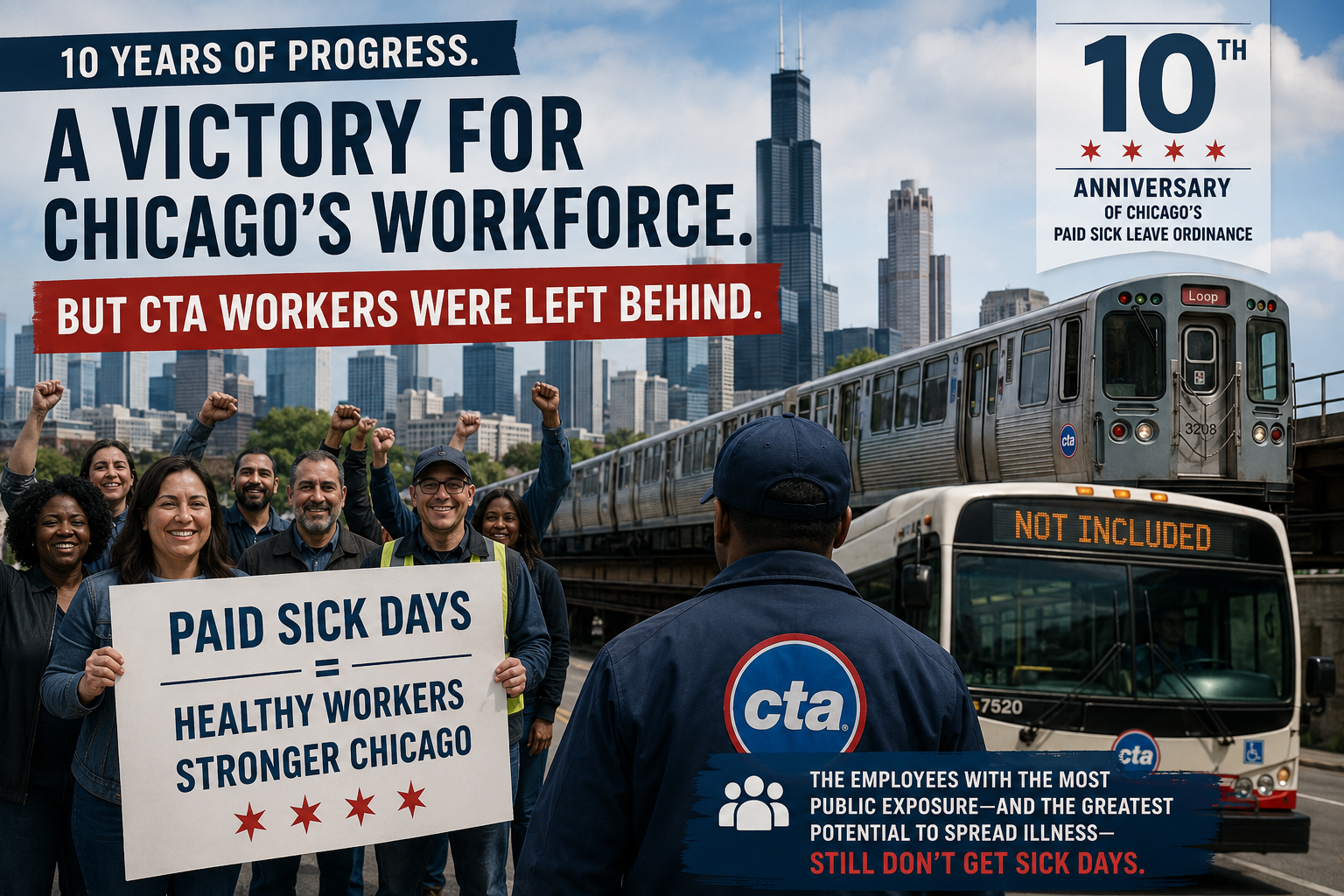
This month marks the 10th anniversary of one of Chicago’s most meaningful workplace reforms: the city’s paid sick leave ordinance taking effect. Championed during Mayor Rahm Emanuel’s administration, the ordinance recognized a simple but important principle: employees should not have to choose between protecting their health and earning a paycheck.
For hundreds of thousands of Chicago workers, that principle became reality. Paid sick leave improved workplace health, reduced the spread of illness, and gave employees the ability to recover from injuries or care for sick family members without sacrificing their financial security. It remains one of the defining labor accomplishments of that era.
Yet one group of employees was notably absent from this victory.
Chicago Transit Authority bus and rail operators—the very workers who interact with thousands of members of the public every day—did not receive the same paid sick leave protections.
The irony is difficult to ignore.
Few occupations involve more daily contact with the public than operating buses and trains. Every shift places transit employees in close proximity to hundreds, and often thousands, of passengers from every neighborhood in Chicago. If preventing the spread of communicable illness is the goal, public transportation should be at the center of that conversation—not on the sidelines.
Transit operators are the people who keep Chicago moving. They transport nurses, teachers, police officers, firefighters, office workers, tourists, and schoolchildren. They report to work during snowstorms, extreme heat, public emergencies, and major city events. During the COVID-19 pandemic, they continued providing an essential public service despite significant personal risk.
Despite their critical role, CTA employees remain outside the protections many other Chicago workers take for granted.
This isn’t simply about employee benefits. It is about public health.
When workers who have constant interaction with the public feel pressure to report to work while ill, everyone shares the risk. Every passenger boarding a crowded bus or train becomes part of that equation. A single operator may interact with hundreds of people in one shift, creating opportunities for illnesses to spread throughout the city.
Paid sick leave was designed to prevent exactly this scenario.
The ordinance acknowledged that healthy employees create healthier workplaces and healthier communities. That same logic applies—perhaps even more strongly—to public transportation.
Ten years after Chicago embraced paid sick leave as a public policy, it is worth asking whether every essential worker has truly benefited from that progress.
Chicago has long recognized transit employees as essential. They are asked to maintain schedules, navigate difficult traffic conditions, respond to emergencies, and safely transport millions of passengers every year. Their work is indispensable to the city’s economy and quality of life.
As Chicago celebrates a decade of paid sick leave, it should also reflect on the workers who were left out.
Public transportation is one of the city’s greatest assets, and the employees who operate it deserve workplace policies that recognize both the value of their service and the realities of their jobs. Ensuring that transit workers have access to meaningful sick leave is not only an investment in employees—it is an investment in every passenger who relies on Chicago’s transit system.
The tenth anniversary of Chicago’s paid sick leave ordinance is certainly worth celebrating. But anniversaries are also an opportunity to examine unfinished work.
Perhaps the next milestone will be remembered not only for celebrating what was accomplished in 2016, but for finally extending the same public health principles to the frontline transit workers who have been helping Chicago move every day.
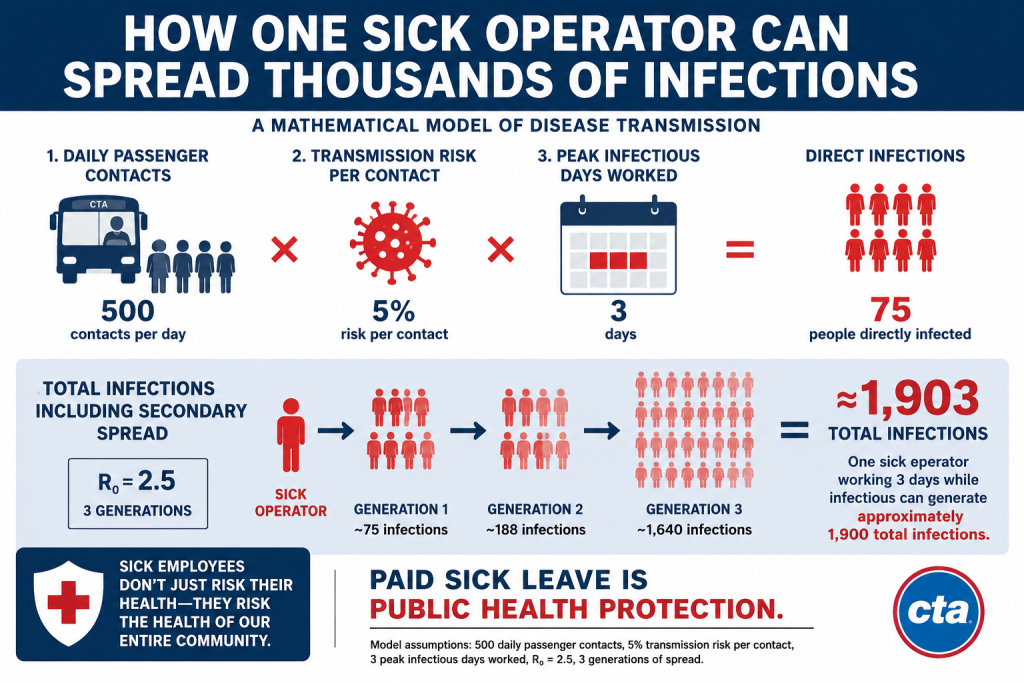
1 Sick Bus Operator=1900 Possible Infections
Using a conservative mathematical model, a single bus operator who works while contagious could expose hundreds of passengers each day. Assuming 500 passenger interactions per shift, a 5% transmission rate, and three days worked during the most infectious period, that operator could directly infect approximately 75 people. When secondary and tertiary transmission are considered, the total impact could grow to nearly 1,900 infections. This illustrates how encouraging sick employees to work doesn’t just affect one individual—it has the potential to amplify disease transmission throughout the community, making adequate sick leave an important public health and workplace safety measure.
No responses yet