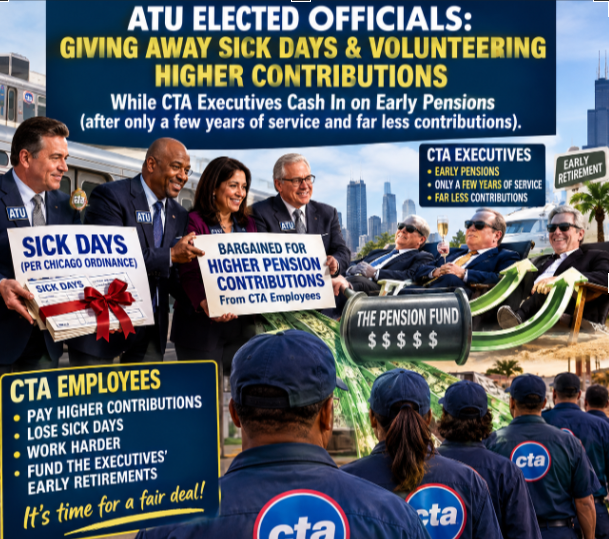
While costs are rising for everything from groceries to gas, a quiet financial crisis is crippling the Chicago Transit Authority from within. The “Blue Collar Pension, ” also referred to as “bargained for employees” is no longer a safety net; for the lowest-paid employees, it has become a crushing burden that is fueling massive turnover. Meanwhile, a close look at the books reveals that a select group of former executives and officials have awarded themselves a golden parachute that is 40.6X times larger than what a typical CTA Frontline Worker (Bus/Rail) can expect to receive in a lifetime.
This isn’t just a tale of corporate greed. This is a systemic rigging of the financial system by a powerful few, designed to penalize the very taxpayers and workers who keep Chicago moving.
The Burden on the Blue Collar Workforce
For the average CTA bus operator, the promise of a pension has become a financial trap. Over the last 15 years, pension contributions for these employees have skyrocketed. While executives have engaged in creative accounting to pad their own retirement accounts, the lowest-paid CTA employees have watched their contribution rates increase by approximately 400%.
Today, these workers are forced to contribute 14.795% of their gross pay just to fund a pension plan that offers significantly less security than it did a generation ago. This massive payroll deduction leaves operators with less take-home pay to deal with inflation, putting a severe strain on their ability to support their families.
The result is predictable and devastating: high turnover and a demoralized workforce. Young operators, in particular, are looking at their pay stubs and realizing that they are paying exorbitant amounts into a system that may not be there for them, or that is so heavily skewed toward the upper echelons that it offers them little incentive to stay.
The Blue Collar (Bargained For Employees) vs. Executive Comparison
To truly understand the scale of this inequity, we must look at the financial mechanics of what happened. Using a 2009 CTA Bus Operator benchmark as a baseline—assuming a 25-year career and retirement at age 65—the operator would contribute roughly $86,346** to their pension and receive approximately **$525,991 over the course of their retirement.
That is a return multiple of 6.09x on their contributions.
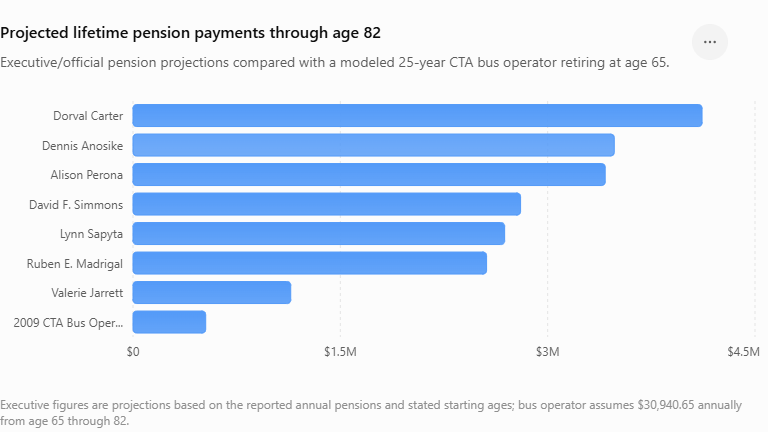
Now, compare that to the “special pension arrangements” that were secured by high-level executives. These executives paid significantly less into the system but are scheduled to draw staggering amounts through age 82.
- Dorval Carter: Paid $244,853** | Lifetime Pension to 82: **$4.1 million | Return: 16.81x
- Dennis Anosike: Paid $96,853** | Lifetime Pension to 82: **$3.48 million | Return: 35.95x
- Alison Perona: Paid $135,572** | Lifetime Pension to 82: **$3.41 million | Return: 25.20x
- David F. Simmons: Paid $27,652** | Lifetime Pension to 82: **$2.8 million | Return: 101.41x
- Valerie Jarrett: Paid $11,132** | Lifetime Pension to 82: **$1.14 million | Return: 102.51x
The Bigger Picture: 40.6X Times the CTA Frontline Worker
While the individual ratios are shocking, the collective total tells the biggest story.
If we combine the projected lifetime payments for these eight individuals, they are set to receive over $21.35 million**. Meanwhile, the hypothetical 25-year CTA frontline transit worker—who actually pays more out of pocket—will receive just **$525,991.
This means the eight executives are set to receive the equivalent of 40.6 lifetime pension payouts for a single CTA bus operator.
This is not a flaw in the system; for many, it appears to be the feature. These arrangements represent one of the most aggressive pension heists in history, executed with the public’s own money. It reveals a system where those at the top rigged the rules to penalize the lowest-paid workers and the taxpaying public, all while insulating themselves from the financial hardships they impose on the workforce.
| Amount Paid | Lifetime Pension to 82 | Return Multiple | |
| 2009 CTA Bus Operator | $86,346 | $525,991 | 6.09× |
| Valerie Jarrett | $11,132 | $1,141,120 | 102.51× |
| David F. Simmons | $27,652 | $2,804,058 | 101.41× |
| Ruben E. Madrigal | $34,080 | $2,558,027 | 75.06× |
| Lynn Sapyta | $52,489 | $2,688,648 | 51.22× |
| Dennis Anosike | $96,853 | $3,481,830 | 35.95× |
| Alison Perona | $135,572 | $3,416,192 | 25.20× |
| Dorval Carter | $244,853 | $4,116,870 | 16.81× |
A Path Forward: A 9% Cap for All
The solution to this crisis is not complicated, and it does not require bankrupting the CTA or punishing its workers. It requires simple, transparent fairness.
We must implement a 9% pension contribution cap for all CTA employees—from the newest bus operator to the highest-ranking executive.
Currently, the lowest-paid workers are paying nearly 15% of their gross pay into a system that offers them diminishing returns, while executives have paid a fraction of that percentage and reaped extraordinary rewards. This is unsustainable, unjust, and driving away the very people the CTA needs to serve Chicago’s riders.
A 9% cap would achieve three critical goals:
- Reduce Turnover: Younger workers would see a clear path to financial stability without sacrificing 15% of their paycheck. This would make CTA careers more attractive and stem the tide of operators leaving for other industries.
- Improve Morale: When workers see that the rules apply equally to everyone—from the executive suite to the driver’s seat—trust in the system is restored. A fair pension is a powerful motivator; an unfair one breeds resentment and disengagement.
- Keep Streets Safer: Perhaps most importantly, a fair pension system encourages experienced employees to stay longer. The safest buses and trains are driven by operators with decades of experience. By keeping our most skilled workers on the job, we keep Chicago’s streets safer for everyone.
Restoring Fairness to the CTA Pension System
The numbers don’t lie. The CTA pension system has been weaponized against the very workers who keep the city moving. While eight former executives are set to collect the equivalent of more than 40 lifetime bus operator pensions, the operators themselves are paying a crippling 15% of their paychecks into a system that offers them a fraction of the security.
This is not just a financial crisis; it is a moral crisis. It represents a systemic failure of governance, where those with power and influence rewrote the rules to benefit themselves at the expense of taxpayers and the workforce.
The solution is simple and fair:
- Institute a 9% cap on pension contributions for all employees, ensuring that no worker is forced to sacrifice an unfair share of their paycheck.
- Separate and publicly account for the special executive arrangements that do not conform to standard pension guidelines, ensuring transparency and accountability.
These steps would reduce turnover, improve morale, and keep experienced operators on the job longer—making Chicago’s streets safer and its transit system stronger. The CTA belongs to the people of Chicago, not a privileged few who have rigged the system in their favor. It is time to restore fairness, transparency, and accountability to the pension system that serves the workers and riders who depend on it every day.
No responses yet